TL;DR
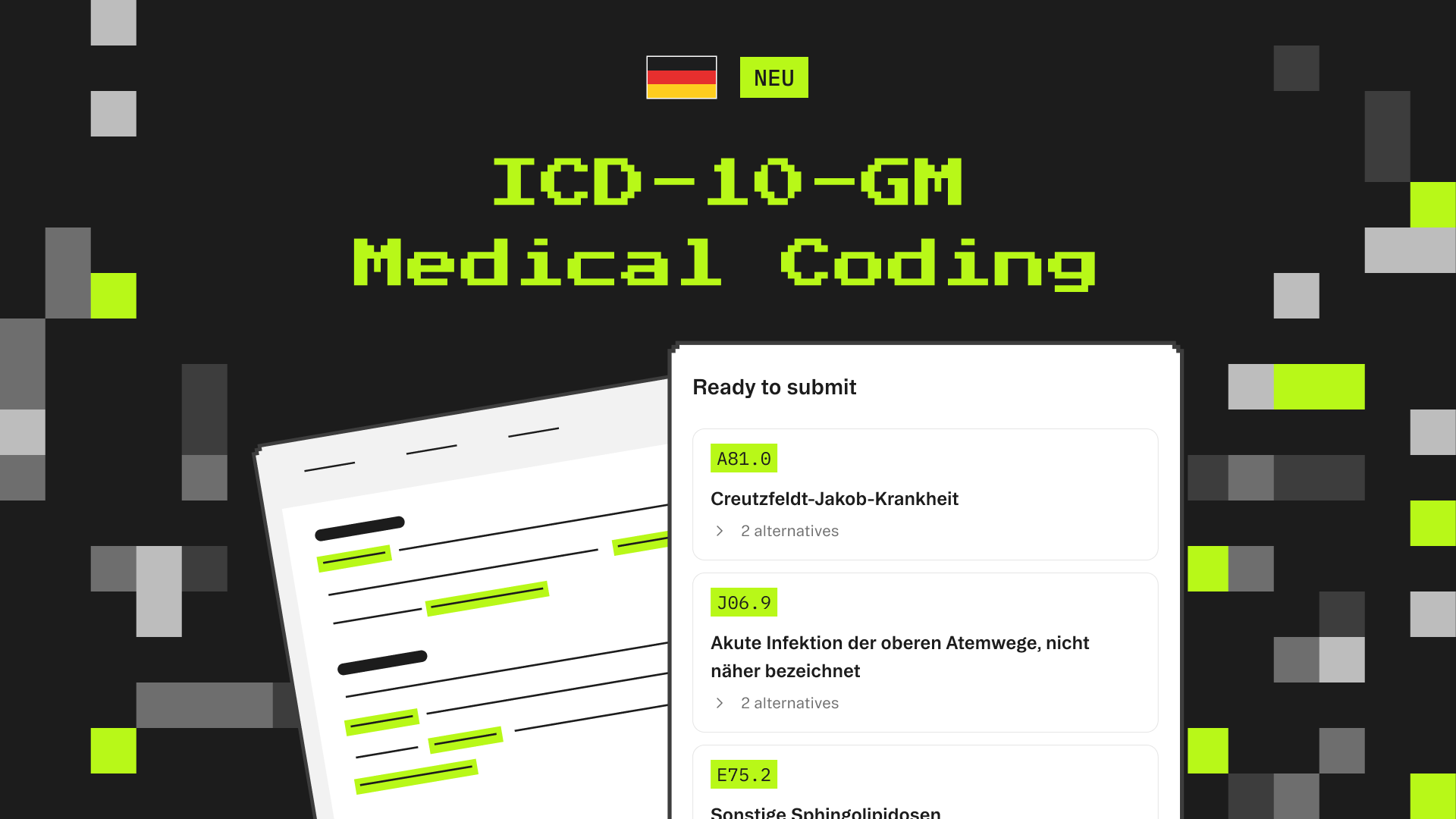
- Corti has launched ICD-10-GM in Symphony for Medical Coding, covering both inpatient and outpatient German diagnosis coding.
- Symphony handles the full complexity of the German system and is production ready for deployment by builders today.
- Corti partner S3 Praxiscomputer has already integrated it into a live ambient clinical workflow, where suggested ICD-10-GM codes are pushed directly into the billing form and patient record, allowing physicians to finalize documentation with a single click.
- Available now through the Corti API. Get started with $50 free credits in our AI Studio.
Upgrading Symphony for Medical Coding with ICD-10-GM
Today, we are expanding Symphony for Medical Coding to support ICD-10-GM, giving Germany's ecosystem of healthcare developers access to the same reasoning-based medical coding engine that has outperformed Google, OpenAI, and Anthropic by more than 25%. One API call. Inpatient and outpatient. Production ready today.
German medical coding is its own discipline
Germany has one of the most demanding medical coding environments in the world. Symphony for Medical Coding now natively understands it.
When Corti launched Symphony for Medical Coding in April 2026, we described coding as a reasoning problem, not a labeling problem. A trained coder does not match text to codes. They interpret clinical context against a structured rule system, apply guidelines that govern what should and should not be coded, and produce defensible, auditable output.
In Germany, that rule system is notably more complex than in most markets.
ICD-10-GM is maintained by the BfArM and updated annually. It underpins the G-DRG reimbursement system, which means every code carries direct financial consequence.
As we documented in our Struck by a Duck report, ICD-10-GM is also a record of how Germany lives, and sometimes how it gets hurt. Germany's festival calendar shows up in hand laceration spikes. There is a billable code for Burnout (Z73.0), for lack of leisure time (Z73.2), and for social role conflict (Z73.5).
These sit alongside codes that capture the full texture of German clinical life: occupational exhaustion, festival injuries, and encounters with farm animals that did not go well.

Bizarre by appearance, clinically real in practice. Symphony reasons over the entire ICD-10-GM hierarchy, edge cases included.
Because Symphony reasons from codified rules rather than patterns learned from training data, extending to ICD-10-GM did not require a new model build or annotated German clinical data. Symphony traverses the ICD-10-GM hierarchy the way an expert coder would: reading the clinical note, applying the guidelines, and returning the most specific defensible code with a written justification for every prediction.
How S3 Praxiscomputer uses Symphony for Medical Coding in production
S3 Praxiscomputer integrated Symphony for Medical Coding into an ambient clinical workflow already in use across German outpatient settings.
After the patient-physician consultation ends, the system extracts structured clinical facts from the conversation transcript, leveraging Symphony FactsR and processes them through an LLM-based analysis layer. Symphony for Medical Coding then receives those structured facts and returns suggested ICD-10-GM codes with justification for each prediction.
.png)
The suggested diagnoses are pushed directly into the billing form and stored in the patient record. Referral recommendations and follow-up actions are surfaced alongside the codes. The physician reviews and confirms. The entire documentation workflow, from transcript to finalized record, is completed in a single click.
For physicians, it means significantly less administrative effort after each consultation, time that stays with the patient instead.
This is what Symphony is designed to support. Teams building applications serving the point of care and embedding a coding layer into the clinical encounter itself, operating fast enough to be useful before the physician moves to the next patient.
Available now in AI studio and via API
CD-10-GM is available to test today in Corti AI Studio. Paste clinical context, select ICD-10-GM Inpatient or Outpatient, and Symphony returns ranked codes with the exact evidence from the note for each prediction.
When you are ready to build, the same capability is available directly through the Corti API.
Start building today with $50 free credits in AI Studio
Go deeper on Symphony for Medical Coding Docs
Build faster. Ship safer. Scale smarter.
Get started with healthcare-native APIs built to power real clinical workflows.