


Corti pre-built Experts: specialized agents for coding, clinical references, and drug lookups
What is an expert?
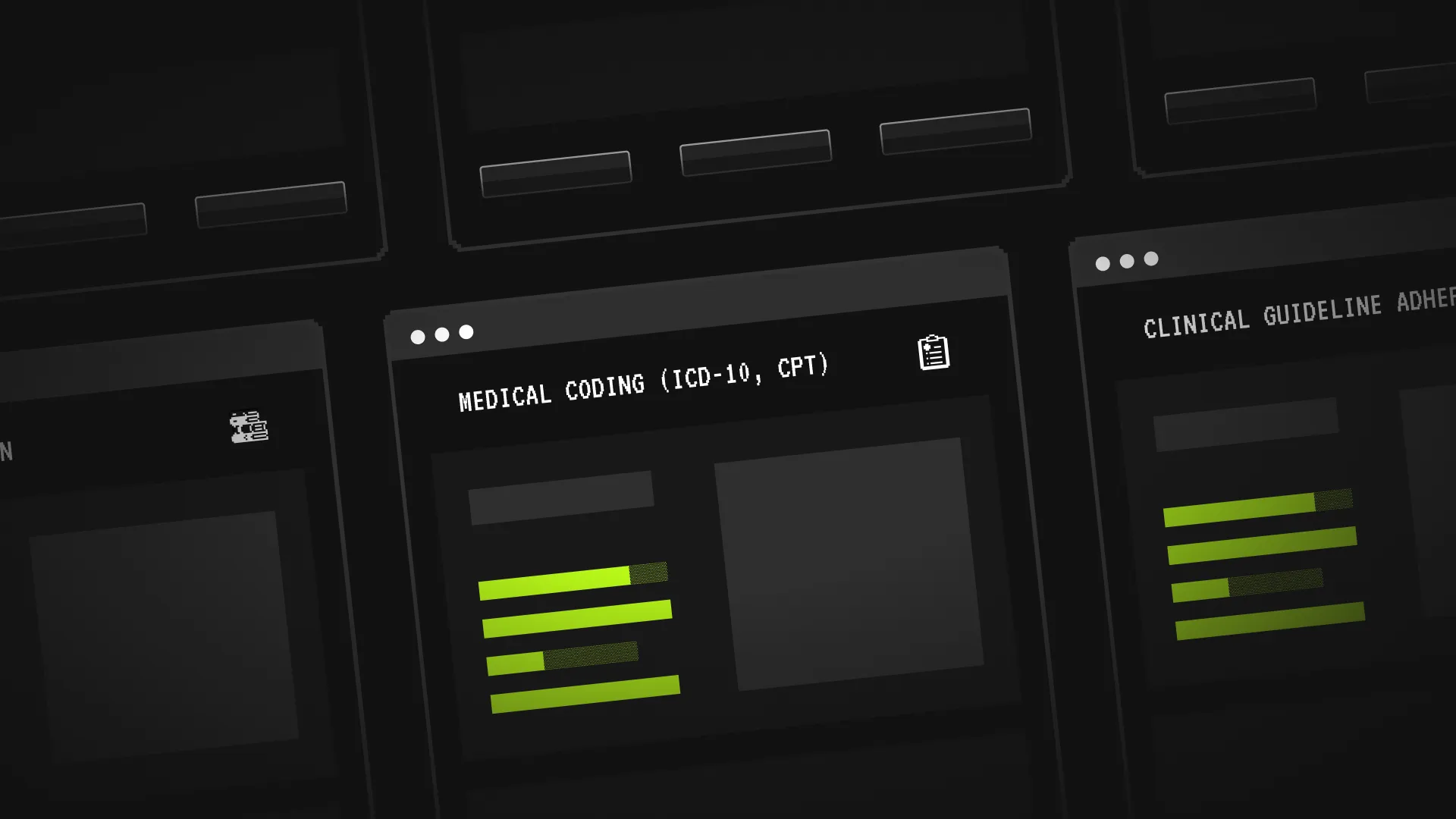
An expert is a pre-configured agent with tightly scoped domain intelligence and tools. Unlike a general-purpose agent that tries to do everything, an expert is designed to do one thing well.
A coding expert handles ICD-10 and CPT lookup. A clinical reference expert retrieves guideline information. A pharmaceutical expert checks drug interactions. Each expert has its own system prompt, tools, and focused context.
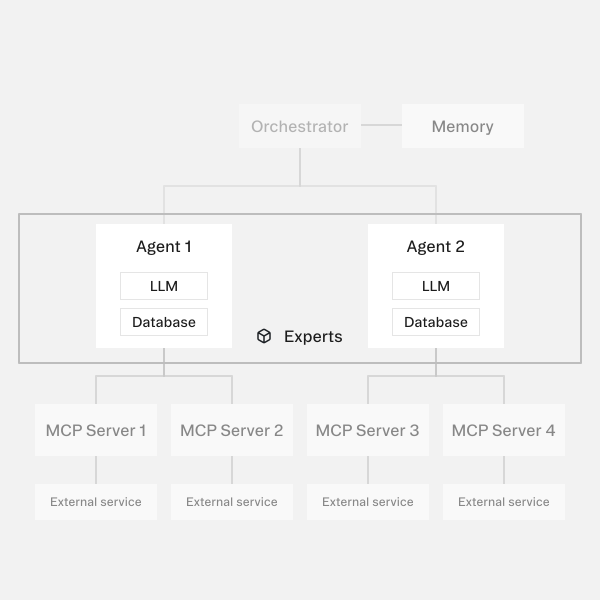
The orchestrator composes these experts into workflows. You describe what you need done. The orchestrator routes tasks to the right experts, calls them in parallel when appropriate, and assembles the output.
Available experts
Corti maintains a registry of experts for common healthcare tasks. All are MCP-compatible and can be called by the orchestrator based on the task at hand.
Clinical knowledge and research
- Amboss Researcher: Clinical reference and medical knowledge
- PubMed: Biomedical literature search across 35+ million articles
- Thieme: Medical reference content
- ClinicalTrials.gov: Active clinical trial search and eligibility matching
Pharmaceutical
- DrugBank: Drug information, mechanisms, and pharmacology
- Posos: Drug interactions, contraindications, and dosing guidance
Revenue cycle
- Medical Coding: ICD-10 and CPT code lookup and validation
Clinical utilities
- Medical Calculator: Clinical calculations (eGFR, BMI, risk scores, unit conversions)
- Questionnaire Interviewing: Structured data collection and patient intake
General
- Web Search: Scoped web retrieval for guidelines, policies, and external information
You can browse available experts through the Expert Registry API, which returns information about each expert's capabilities, descriptions, and configuration requirements.
Bring your own expert
The registry is not limited to what Corti provides. You can create custom experts by exposing an MCP server and registering it with the framework.
When you register your MCP server, Corti wraps it in an LLM agent with a system prompt you control. Your expert then becomes available to the orchestrator alongside Corti's built-in experts.
What this enables:
- Integrate your own tools and data sources
- Create domain-specific experts tailored to your workflows
- Maintain control over behavior through custom system prompts
- Use Corti's orchestration and memory management with your own tools
Configuration is straightforward. You provide expert metadata (ID, name, description), a system prompt that controls how the agent reasons about tasks, and your MCP server details including transport type and authentication.
Once registered, your custom expert works seamlessly in multi-expert workflows.
Your experts get the same guarantees
Custom experts are not second-class citizens. When you integrate your own MCP, it inherits the same safety guarantees and visibility features as Corti's native experts.
- Access control and data segregation. The orchestrator enforces user-level permissions for your expert just as it does for built-in ones. Your expert stays confined to the end user's access permissions for the thread it is serving.
- Parameter-level controls. Corti implements
input_modedefinitions that specify whether each parameter must be injected programmatically, generated by the agent, or provided by the user. Your custom experts are subject to these same rules, preventing hallucinated identifiers and ensuring data integrity. - Human-in-the-loop. Any tool can declare
human_interrupt_required: true, which halts execution and requires explicit human approval before proceeding. This works for your custom tools just as it does for Corti's. - Full tracing. No message passes between the orchestrator and any expert without being validated and logged. This applies to customer-built experts too. Every decision, action, and data flow is captured and traceable.
The framework upgrades your MCP with production-grade governance. You build the domain logic. Corti handles the safety infrastructure.
Focus on building what really differentiates your product
Every expert you do not have to build is time saved. Every integration you do not have to maintain is complexity removed.
Clinical reference, coding, drug information, literature search. These are solved problems. Start with them. Focus your engineering time on the workflows and user experiences that differentiate your product.
More guides to explore

Build faster. Ship safer. Scale smarter.
Get started with healthcare-native APIs built to power real clinical workflows.