


Healthcare agent infrastructure for production: compliance, audit trails, and scale at volume
The production problem
Conventional engineering challenges (access control, data governance, scalability, version compatibility) become significantly harder when the software is non-deterministic. Agents do not follow deterministic code paths. They reason, select tools, generate outputs. The same input can produce different behavior.
This creates problems that do not exist in traditional software:
- Access control across threads. Multiple users run requests on the same agent backend. The agent has broad access to data and tools, but it must stay within the bounds of each user's permissions. How do you prevent an agent serving one user from accessing data belonging to another?
- Hallucinated identifiers. Agents generate arguments for tool calls. What happens when an agent hallucinates a patient ID or copies the wrong identifier from context? It could access the wrong records without knowing it crossed a boundary.
- Auditable approvals. Many frameworks offer human-in-the-loop intervention as a simple implementation. But healthcare requires more: storing exactly when and who approved an action, in what context, with what information. Every piece of data created or generated must be tagged and stored for auditing.
- Debugging misbehavior. When an agent takes an unexpected action, you need to understand what happened. Multiple agents may have been involved. Multiple messages may have passed between agents and users. Without tracing, you cannot investigate, fix issues, or improve handling of similar scenarios.
- Scaling beyond prototypes. A prototype running locally is easy. An agent framework handling thousands of concurrent users is not. Models, MCP servers, and API backends all need to scale independently based on load.
What building this yourself looks like
The typical approach: start with an LLM provider (Anthropic, OpenAI, Google). Add an agent framework (LangChain, LangGraph, CrewAI, AutoGen). Build orchestration logic. Wire in your tools. Deploy.
Then you discover the production problems:
- Access control is your responsibility. General-purpose frameworks do not enforce user-level permissions across agent threads. You build that logic yourself, audit it, and prove it holds under compliance review.
- Identifier safety is prompt-level. You hope the model does not hallucinate patient IDs. You add prompt guardrails. You monitor for leakage. You build validation layers. You still worry.
- Audit trails are DIY. You log what you think matters. You build the infrastructure to store approvals with context. You maintain it. When compliance asks for a trace of what happened during a specific agent execution, you hope your logging captured it.
- Tracing is fragmented. Each component (framework, model, tools) has its own observability. Stitching together what happened across a multi-agent execution is manual work. Debugging is slow.
- Scaling is your problem. You manage infrastructure for models, tool servers, and orchestration separately. You handle load balancing, failover, and capacity planning.
- Healthcare integrations do not exist. General-purpose frameworks give you tool-calling primitives. They do not give you pre-built, maintained integrations with DrugBank, PubMed, ClinicalTrials.gov, medical coding databases, or clinical calculators. You build each one yourself.
This is months of engineering before you ship anything clinical. And it is ongoing maintenance as your application scales and compliance requirements evolve.
How Corti solves these problems
- Access control enforced at the infrastructure level. Even though an agent may have broad access to data and tools, Corti's framework ensures it stays within the end user's permissions for that specific thread. This is not prompt-level guidance. It is architectural enforcement.
- Programmatic ID injection. Rather than trusting agents to correctly generate identifiers, Corti injects IDs and identifying data points programmatically. This reduces hallucination risk for critical data like patient identifiers to near zero.
- Healthcare-grade audit trails. Every approval is stored with who approved, when, and in what context. Every piece of data created by a user or generated by an expert is tagged and logged. This meets the data governance requirements healthcare settings actually require.
- Full execution tracing. Corti implements tracing across the entire API. You get a complete historical view of what happened during agent execution, even when multiple agents were involved and multiple messages passed between agents and users. When something goes wrong, you can investigate.
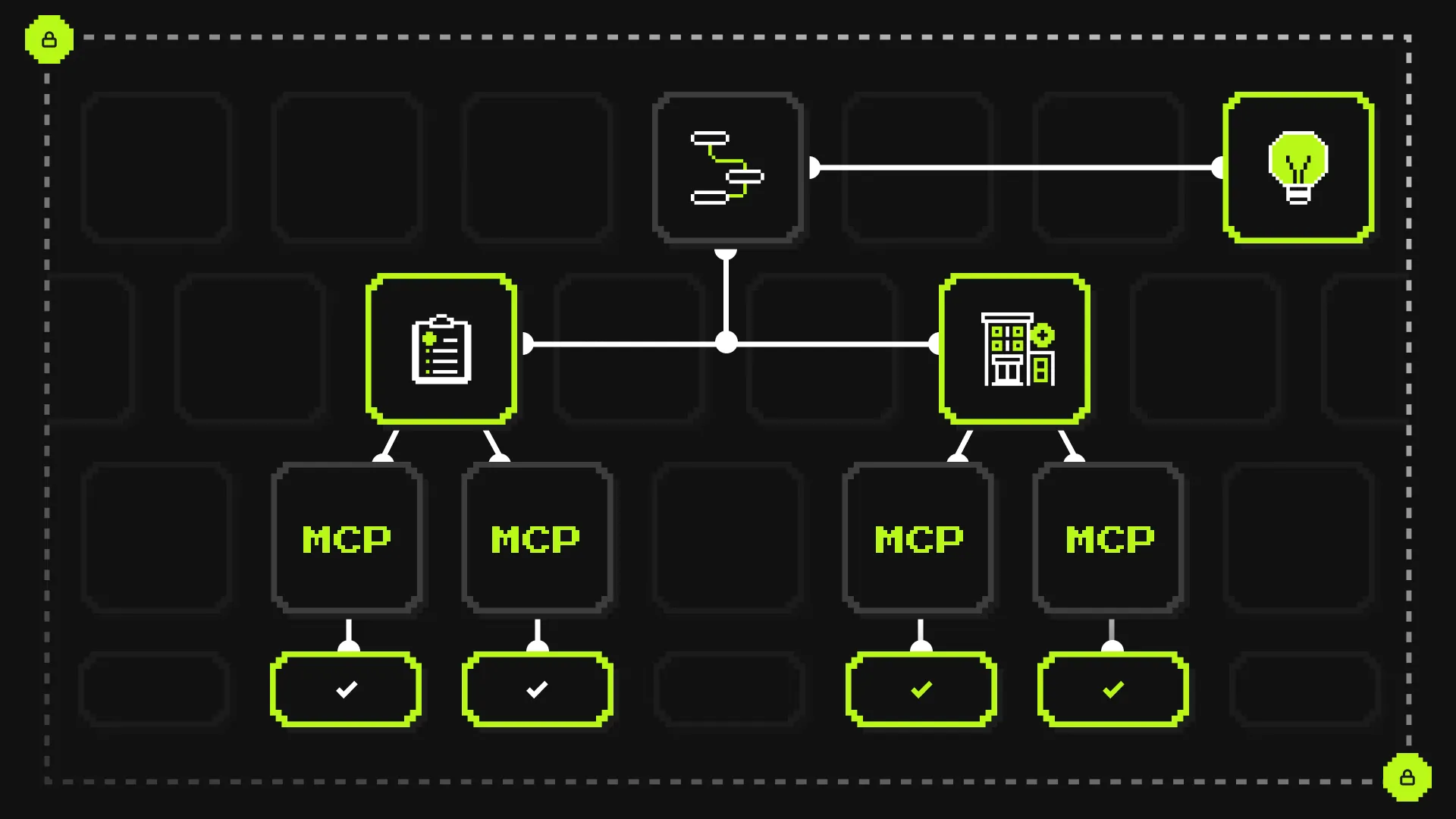
- Horizontal scalability. Models, MCP servers, and API backends scale independently. The framework handles the load of thousands of concurrent users without architectural changes on your side.
- Pre-built healthcare experts. Clinical reference, medical coding, drug information, literature search, clinical calculators. Ready to use, MCP-compatible, maintained by Corti. Bring your own experts for workflows unique to your domain.
Focus on use cases, not infrastructure
These problems are not interesting to solve. They are necessary to solve. They complicate and increase the cost of building in-house agent infrastructure. Every team building healthcare AI encounters them.
Corti has already solved them. The framework adapts to various customer needs while handling access control, governance, auditability, tracing, and scale at the infrastructure level.
You focus on the part that matters: building agents that solve clinical and operational problems for your users.
More guides to explore

Build faster. Ship safer. Scale smarter.
Get started with healthcare-native APIs built to power real clinical workflows.