


Build vs buy healthcare AI agents: a developer decision guide

Option 1: Build from scratch
General-purpose LLM providers give you access to models and basic tooling. You get maximum flexibility, but you also inherit all the complexity.
You need to build your own orchestration layer. Implement guardrails that actually enforce constraints. Handle context management across agents. Build audit trails for compliance. Design access control that does not rely on the model behaving itself. Validate that everything works correctly in production across the entire agentic stack.
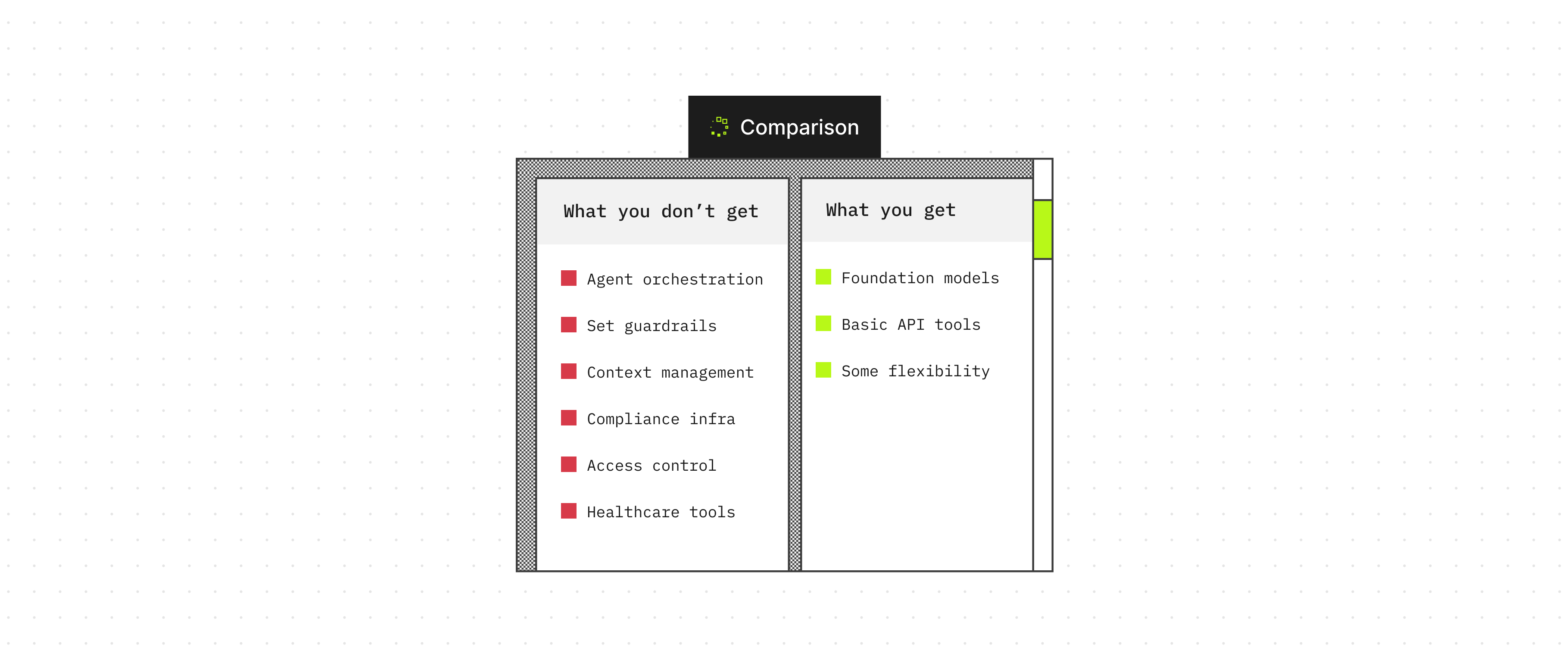
This is months of engineering work before you ship anything useful. And you are solving infrastructure problems instead of building the features that differentiate your product.
For teams with deep AI engineering resources and long timelines, this can make sense. For most healthcare software companies, it means competing on infrastructure instead of business value delivered to your customers.
Option 2: Buy a prebuilt point solution
Prebuilt agents solve a specific problem out of the box. A coding agent. A documentation agent. A triage agent. You get something working quickly with minimal engineering effort. For narrow, well-defined use cases, this approach coule make sense. Fast deployment of a packaged product, minimal setup, immediate value.
The drawbacks emerge quickly. These are point solutions. They handle one workflow, not many. They do not integrate across clinical, administrative, and operational domains. When you need agents that coordinate with each other or share context across tasks, prebuilt agents do not connect.
As a developer, you also have no visibility into what is underneath. You do not know what models are being used, how they are tuned, or how quality is maintained. The agent is a black box. When it makes mistakes, you cannot diagnose why or adjust its behavior.
Customization is limited or nonexistent. If the agent does not fit your workflow, your options are to work around its constraints or abandon it. You cannot modify system prompts, swap out tools, or adapt the logic to your users' specific processes.
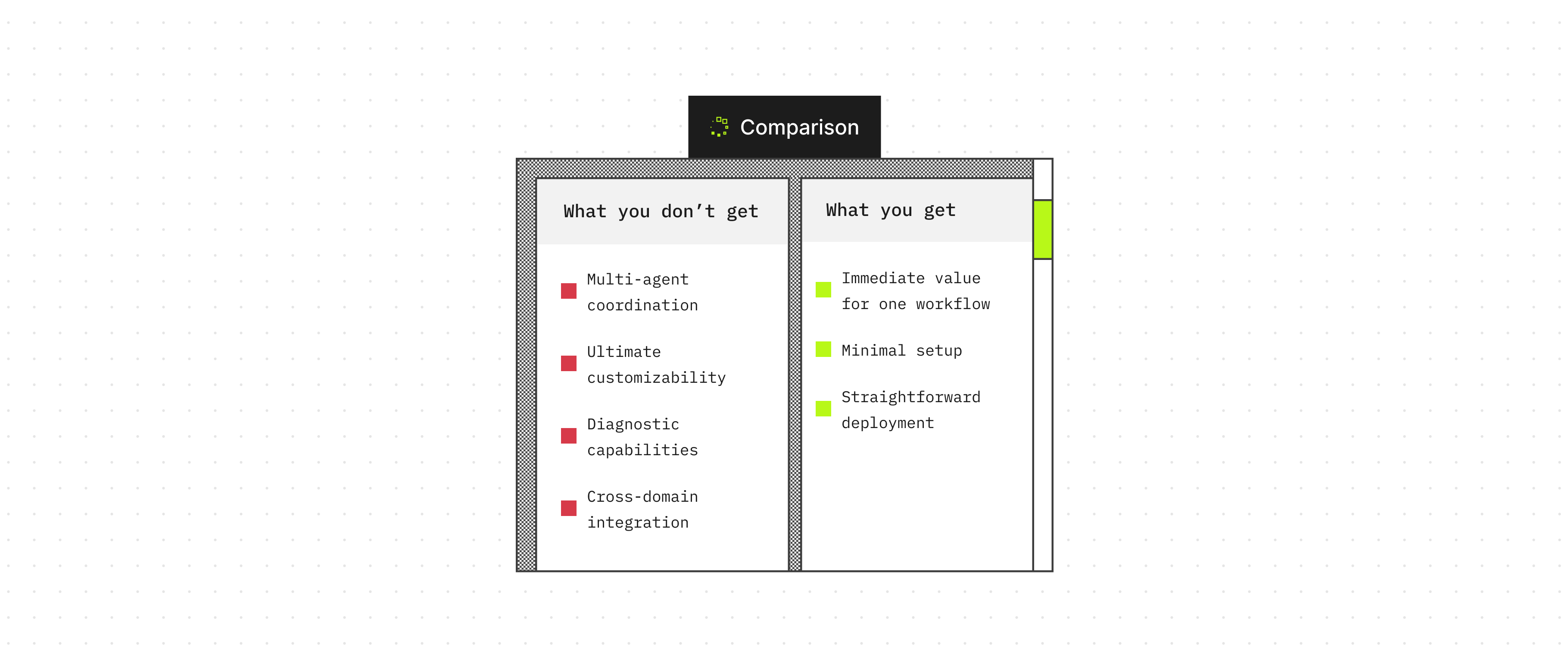
Prebuilt agents can solve a problem. They cannot serve as infrastructure for building differentiated capabilities.
The Third Option: Infrastructure with Healthcare Built In
Purpose-built agent infrastructure gives you the building blocks (orchestration, context management, guardrails, traceability, prebuilt experts) with the flexibility to customize, extend, and integrate.

What you get out of the box:
- Memory and data management. Context windows are limited and filling them degrades performance. You need semantic retrieval to surface relevant information, persistence across sessions, and logic to decide what goes in and what stays out. Purpose-built infrastructure handles this. You do not build your own RAG pipeline or context management system.
- Compliance and auditability. Healthcare applications need HIPAA compliance, SOC 2 certification, audit trails, and data isolation between tenants. Building this yourself means months of security engineering and ongoing maintenance. With purpose-built infrastructure, the compliance layer is already certified and maintained.
- Configurable guardrails. LLMs do not reliably follow instructions just because you ask nicely. Guardrails need to be enforced at the infrastructure level, not hoped for at the prompt level. You get safety constraints that actually work, with the ability to configure them for your use case.
- Context and prompt engineering. What goes into the context window matters. Too much and performance degrades. Wrong structure and the model misses key information. Cache optimization reduces latency and cost. These are solved problems you do not need to re-solve.
- Agent mesh orchestration. Multi-agent systems require coordination: routing tasks to the right expert, handling parallel execution, managing failures, synthesizing results. This is complex infrastructure. You configure which experts to use and how they behave. The orchestration layer handles the rest.
- Healthcare tools and integrations. Prebuilt experts for common healthcare tasks (medical coding, connectors to drug databases, medical calculators, guideline lookup) are ready to use. You can call them directly or let the orchestrator route to them. No need to build integrations with databases or clinical terminology systems from scratch.
- Long-term tech stack maintenance. Models improve. Best practices evolve. Prompt engineering techniques change. Purpose-built infrastructure stays current. You do not manage model migrations or chase the latest optimization techniques yourself.
What you configure:
- Use-case specific adaptations
- Which experts your agents can call
- System prompts and agent behavior
- Custom tools and data sources
You use prebuilt experts for common tasks and extend them or build custom agents for workflows unique to your product. You focus engineering time on what differentiates your application, not on the infrastructure underneath it.
What building on purpose-fit infrastructure looks like in practice
Say you are building a clinical assistant.
- With general-purpose LLM infrastructure: You spend months on orchestration, context management, and compliance before writing any clinical logic.
- With a prebuilt point solution: You get something working quickly but hit customization limits within weeks.
- With purpose-built healthcare agent infrastructure: You start with a working foundation. Prebuilt experts handle documentation, coding, and guideline lookup. You configure the orchestrator's behavior, add your own tools, and focus engineering time on the workflows that differentiate your product.
Build products, not infrastructure
Building from scratch means solving every infrastructure problem yourself. Buying prebuilt means accepting someone else's constraints. Purpose-built infrastructure gives you a third path: flexibility on top of a foundation that already works.
Your team ships clinical workflows instead of orchestration plumbing. Your roadmap moves faster. Your product stays differentiated.
More guides to explore

Build faster. Ship safer. Scale smarter.
Get started with healthcare-native APIs built to power real clinical workflows.