


Hierarchical multi-agent design: orchestrators and experts vs one agent with too many tools
The single-agent ceiling
A single agent with twenty tools sounds elegant. One model, one prompt, one place to debug. In practice though, it is likely to fall apart.
The model has to decide which tool to use on every turn. As tool count grows, selection accuracy drops and the prompt gets longer. Context windows fill up and latency increases, which means when something goes wrong, you are debugging a monolithic system that is taking longer to give reasonable outputs. Also note that, clinical reasoning, billing logic, and scheduling optimization require different context and different expertise. Cramming all of that into one agent means none of it works particularly well.
The orchestrator-plus-experts architecture
The alternative is hierarchical design. Instead of one agent with many tools, you have an orchestrator that coordinates specialized experts.
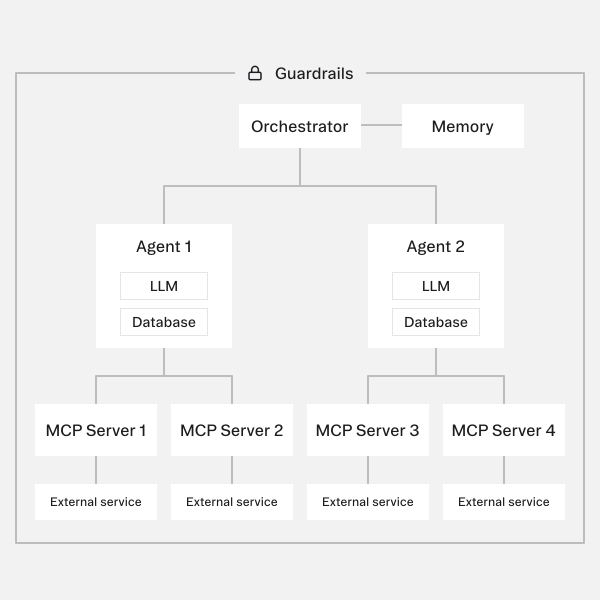
The orchestrator receives user requests, decides which experts to involve, routes tasks, and assembles outputs. It does not try to do the clinical reasoning or the coding logic itself. It delegates.
Experts are tightly scoped sub-agents. A documentation expert handles clinical notes. A coding expert handles ICD and CPT. A guidelines expert retrieves relevant protocols. Each has its own context, its own tools, and its own domain knowledge. Each is optimized for a narrow task.
This mirrors how real clinical workflows operate. A physician does not also do billing and scheduling. Different people with different expertise handle different parts of the process.
Why hierarchical design works better than monolithic design
- Better tool selection. Each expert has a small, focused toolset. The orchestrator only needs to pick the right expert, not the right tool from a list of fifty.
- Cleaner context. Experts operate with context scoped to their domain. The documentation expert does not need to know about scheduling availability. This reduces noise and improves accuracy.
- Easier debugging. When something goes wrong, you can isolate which expert failed and why. The orchestrator's routing logic is separate from the experts' domain logic.
- Stable reasoning. Long prompts with many tools create what you might call prompt entropy. Small changes trigger unpredictable cascades. Hierarchical design keeps each agent's prompt focused and stable.
The Orchestrator’s role
The orchestrator is more than a router. It is essentially the controller for the entire system.
It manages thread state so context persists across turns. It also constructs execution graphs when a task requires multiple experts in sequence. Additionally, it validates every call, enforcing guardrails and governing tool access. And on top of that, it provides traceability so you can audit exactly what happened, which expert did what, and why.
- Thread state management. Context persists across turns. The orchestrator tracks what has been asked, what has been answered, and what is still pending.
- Execution graphs. When a task requires multiple experts in sequence or in parallel, the orchestrator constructs the execution plan. A discharge readiness check can query vitals, labs, medications, and follow-up appointments simultaneously rather than one at a time.
- Guardrails and governance. Every call is validated. Tool access is governed. The orchestrator enforces constraints at the infrastructure level, not just in prompts.
- Traceability. You can audit exactly what happened: which expert did what, with what inputs, in what order, and why. In regulated environments, this is not optional. You need to know who approved what action, with what information, in what context.
- Error handling and escalation. When an expert fails or returns incomplete results, the orchestrator can retry, route to a fallback, or escalate to a human with full context. Failures stay contained rather than crashing the entire workflow.
In regulated environments, this governance layer is not optional. You need to know who approved what action, with what information, in what context. The orchestrator makes that possible.
Why production multi-agent systems for healthcare need this design
Hierarchical design gives you reliability that single-agent architectures cannot match. Experts stay focused. Context stays clean. Failures stay isolated. And the orchestrator ensures that everything is governed and traceable.
This is why production-grade agent infrastructure is built this way. Not because it is theoretically elegant, but because it actually works at scale in high-stakes environments.
- Patient safety depends on accurate outputs. A coding error affects reimbursement. A medication interaction missed by an overloaded agent affects patient health. When agents operate in clinical workflows, accuracy is not a nice-to-have. Focused experts with clean context produce better results than a single agent juggling everything.
- Regulatory environments demand traceability. HIPAA, SOC 2, and internal compliance policies require audit trails. You need to show what data was accessed, what logic was applied, and what output was produced. The orchestrator's governance layer makes this possible by design, not as an afterthought.
- Failures need to be isolated. In a monolithic agent, one bad tool call can derail the entire workflow. In hierarchical design, a failing expert does not take down the system. The orchestrator can retry, route to a fallback, or escalate with full context. The rest of the workflow continues.
- Debugging at scale requires visibility. When something goes wrong in production, you need to know where it went wrong. Was it the orchestrator's routing? A specific expert's reasoning? A tool returning bad data? Hierarchical design gives you that visibility. Monolithic agents give you a black box.
- Healthcare workflows span domains. Clinical reasoning, billing logic, scheduling, prior authorization, documentation. These are different disciplines with different data sources and different expertise. No single agent handles all of them well. Hierarchical design matches the architecture to the problem.
This is why production-grade agent infrastructure is built this way. Not because it is theoretically elegant, but because it works at scale in environments where mistakes have real consequences.
More guides to explore

Build faster. Ship safer. Scale smarter.
Get started with healthcare-native APIs built to power real clinical workflows.