.webp)
TL;DR
Medication reconciliation compares a patient's medication list against current orders at care transitions like admission, transfer, and discharge, to catch errors, duplications, and interactions. Up to 40% of medication errors happen during these transitions. AI agents on Corti can automate medication reconciliation, with built-in governance and auditability.
Up to 40% of medication errors happen during care transitions. About one in five of those cause harm.
The task sounds simple: list everything a patient takes, compare it against current orders, flag problems. In practice, the data lives in multiple systems. Patients forget to mention OTC medications. Pharmacy records contradict the EHR. A pharmacist has to piece it all together under time pressure, usually across phone calls and fax machines.
Consider a patient with diabetes, hypertension, and chronic kidney disease who gets admitted with conflicting medication lists from two specialists. Her pharmacy records don't match her EHR. She's been taking an OTC NSAID she didn't bring up, and it interacts with her other drugs. One missed step and she's on a dangerous combination.
This is a multi-source, conditional reasoning problem with real consequences. It's also the kind of work agents are good at.
Building a medication reconciliation agent on Corti
Corti's Agentic Framework gives healthcare developers infrastructure for workflows like this. Orchestration, guardrails, auditability, and compliance are built into the framework itself.
1. Start with the Medication Reconciliation Agent template
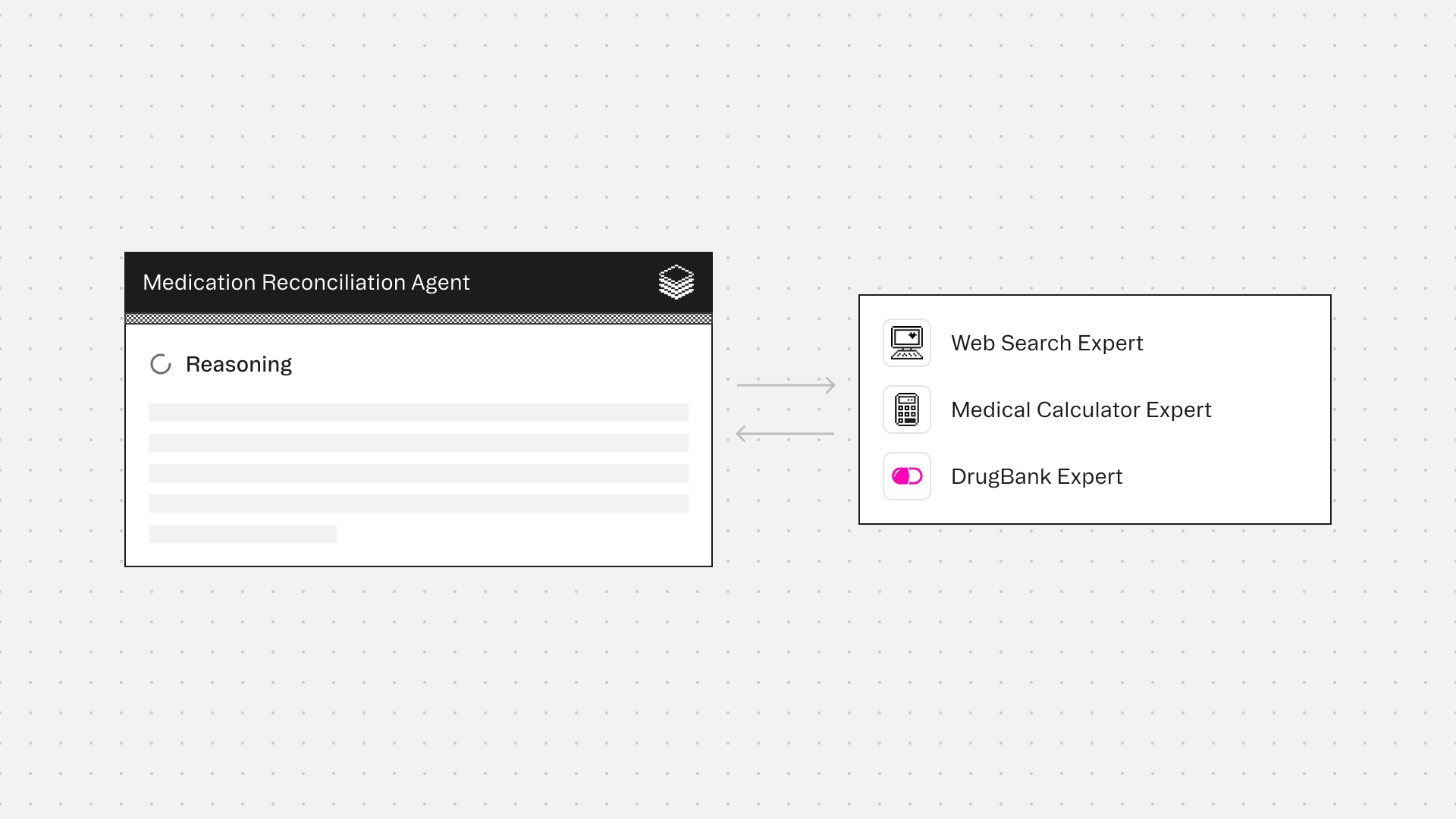
The Agent Library includes a Medication Reconciliation Agent that reviews medications against clinical records. It ships with specialized Experts (modular AI components for tasks like drug database lookups, dosage calculations, and clinical knowledge retrieval). You can deploy it directly or customize it.
2. Combine reasoning with domain expertise
The framework runs a multi-agent architecture. An orchestrator coordinates Experts, each with tightly scoped domain intelligence. For medication reconciliation, you'd configure your agent to use the DrugBank Expert for drug intelligence, the Medical Calculator Expert for dose calculations, a Web Search Expert for current clinical guidance, and custom Experts you build via MCP to connect your EHR or pharmacy systems.
The orchestrator validates each action and keeps a full audit trail. It pulls from trusted sources instead of guessing.
3. Define the workflow and context
You configure the agent's system prompt to lay out the reconciliation workflow: collect data from EHR medication lists, pharmacy records, and patient interviews. Normalize drug terminology. Compare lists. Flag discrepancies. Produce a reconciled output.
Each request includes patient context, including structured FHIR medication resources, so the agent works with real clinical data at runtime.
The output is a reconciliation summary with discrepancy flags and documentation gaps that need clinician review.
.png)
4. Deploy with built-in governance
Corti agents run under a central orchestrator that validates actions, enforces execution rules, and stops agents from acting outside their scope. Every decision and tool invocation gets logged with replayable traces. Agents can pause for human approval when needed.
5. Integrate and iterate
Use the Corti Console to authenticate, create your agent, configure its Experts, and test. The framework supports the Agent-to-Agent (A2A) spec for interoperability and MCP for connecting to compatible systems. Start with a prototype for one part of reconciliation and extend from there.
The SDK is available for Node.js and browser environments. Full API docs at docs.corti.ai.
Why agents?
You can't solve medication reconciliation with a single prompt. The task has variable inputs, conditional logic, data from multiple systems, and clinical judgment baked into every step. Agents let you encode that reasoning into a governed, auditable system that actually works in production.
Explore the Agentic Framework docs, browse the Agent Library, and start building.
Build faster. Ship safer. Scale smarter.
Get started with healthcare-native APIs built to power real clinical workflows.