


Struck by a Duck
What bizarre billing codes reveal about how each country actually lives (and gets hurt).

Introduction

Joakim Edin is an AI researcher at Corti, and one of the architects of Symphony for Medical Coding, the breakthrough agentic model described in this report.
You are ordering plane tickets. You have written your name, passport number, and date of birth, and now you must select your profession from a drop-down menu. To your horror, the drop-down menu has 14,000 options. You scroll through the endless list of professions: Superyacht Interior Outfitting Coordinator, Competitive Eating Event Logistics Manager, Haunted Attraction Prosthetics and Gore Technician, Medieval Reenactment Armorer, Plate and Chain Specialization, and so on. After half an hour, you finally find your profession: School Teacher. You ordered the tickets, but your request has been denied. The airline company found out that you are a high school teacher, and that school teacher was too vague.
Now, move away from your laptop and go to the hospital.
Every time a patient sees a doctor, someone must document each diagnosis by finding the correct label from a list of more than 14,000 options. In the United States, that list has 72,000 options. These labels are called medical codes. They determine whether the hospital gets paid, whether the insurance claim goes through, and whether the visit gets counted in national health statistics. Find the wrong one, and the consequences range from a rejected bill to a patient’s medical history reflecting the wrong thing.
Many of these codes, at first glance, seem absurdly specific. There is a code for burns due to water skis on fire. There is a code for problems with your in-laws. There is a code for injuries sustained while knitting, and separate codes for tackle football and flag football. In London, lampposts were once padded because so many people were walking into them while looking at their phones - and yes, there is a code for that too. There is even a code for being struck by a duck.
But the specificity is not madness. It exists because the system must account for everything, even the absurd. In this report, we will demonstrate this by analyzing the most frequent codes in each country. An anthropological study told with alphanumeric codes. The codes will tell a story of how people in each nation live: what animals they share space with, what they do on weekends, how they celebrate, and what their domestic life looks like from the emergency room.
With this knowledge, the governments can make policies to prevent injuries and deaths. This is why reporting these sometimes absurdly specific codes is so important. It helps us understand society, so that we can improve it.
Deer on the Highway, Fireworks in the ER, & the Code for Flag Football.
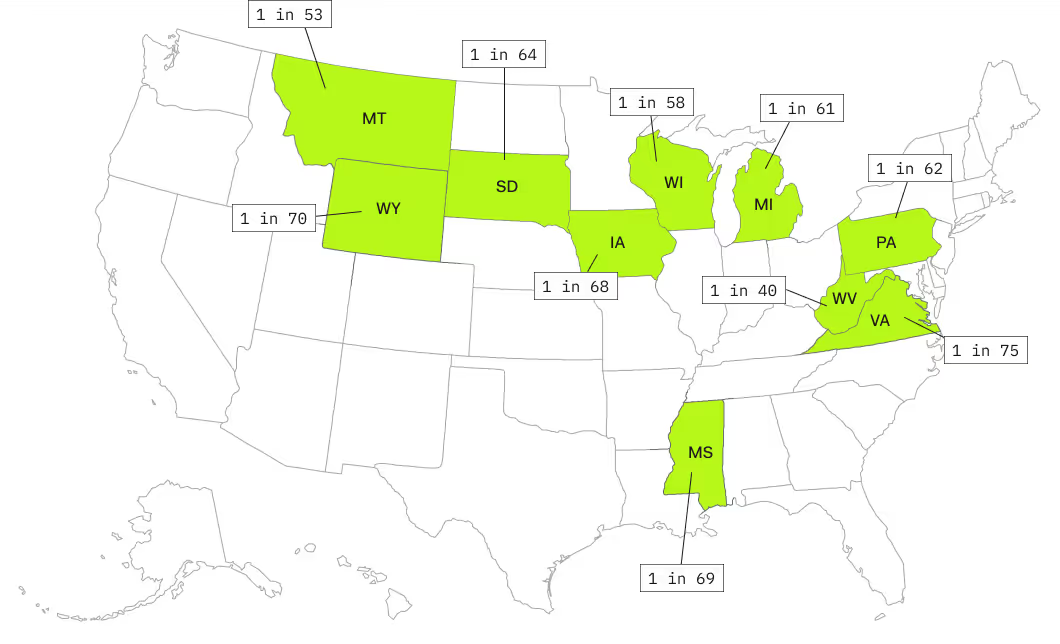
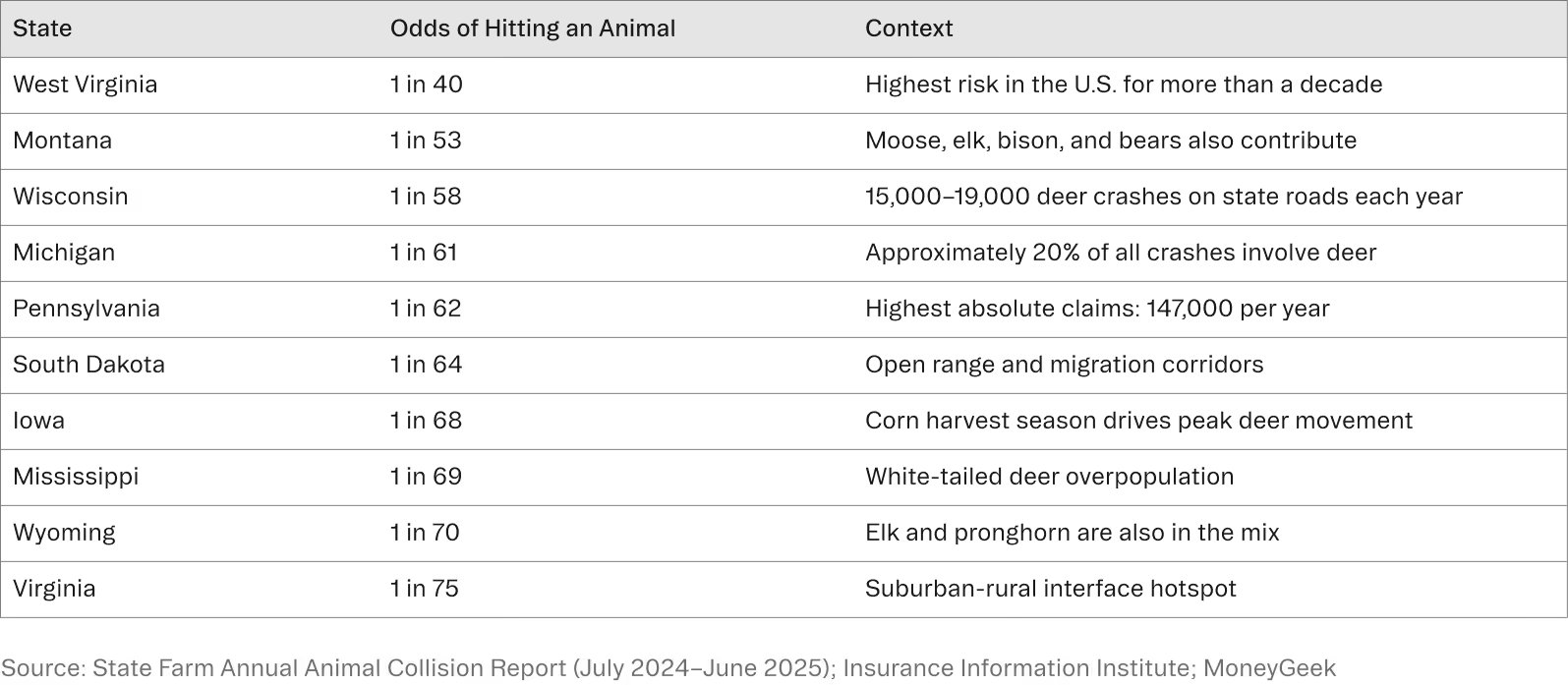
Last year, the animal that cost American drivers the most money was not a thoroughbred. It was a white-tailed deer crossing a rural highway at dusk.

Oh deer! The $10 billion problem
Between July 2024 and June 2025, American drivers filed 1.7 million animal collision insurance claims. Of these, 1.1 million involved deer - 65% of all animal collisions, with total economic losses estimated at $10 billion annually. Collisions are 14 times more likely in the two hours after sunset. Peak months are November, October, and December, accounting for 41% of all claims.
Rockets’ red glare: The 4th of July surge
On July 4th and 5th, more than 45,000 people visit U.S. emergency rooms. In 2024, fireworks-related ER visits reached 14,700 - a 52% increase over 2023. The fireworks code (W39) ranks 196th among annual injury causes but surges to 16th during the holiday window. Sparklers alone caused 1,700 ER visits. They burn at approximately 2,000°F.
Source: U.S. Consumer Product Safety Commission (2024); Pew Research Center / NEISS data
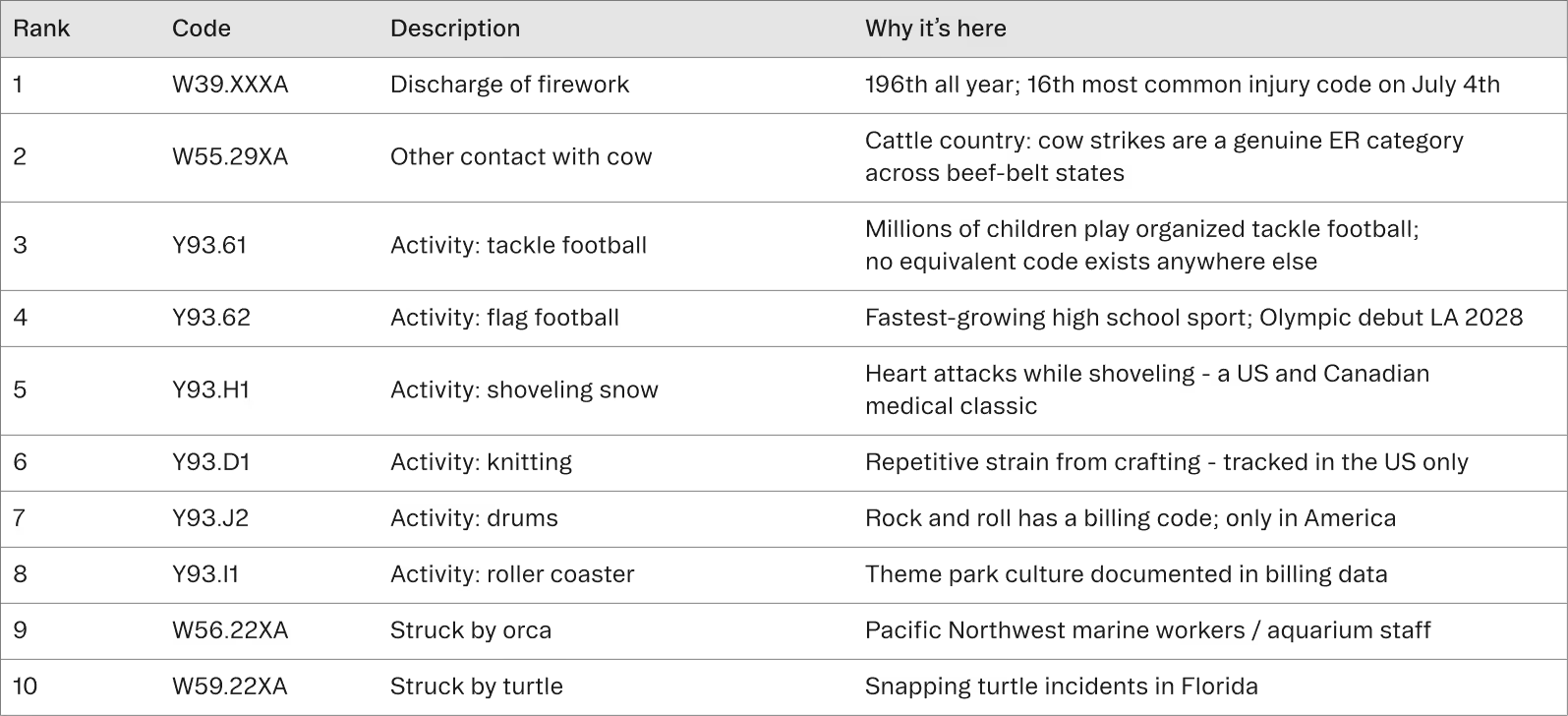
The off-beat code rankings: U.S. edition
Ranked by event frequency and cultural specificity 1 - focused on codes that reveal something distinctively American.
What the data tells us
The entire Y93 activity chapter - hobbies, sports, domestic activities - does not exist outside the U.S. A medical coder, or an AI system, working across borders must understand not just which codes to use, but which entire code chapters exist in each system - and what to do when they don’t.
1 Codes are ranked by a combination of documented event frequency and cultural specificity to the US. Raw national coding volume for external cause codes is not publicly available at this granularity. Each entry is a real, active, billable ICD-10-CM code anchored to a cited data source. Ranking position reflects illustrative value, not a claim that code 1 is filed more often than code 10.
Last Orders, Lampposts,and the In-Laws.
Britain’s most revealing healthcare data isn’t about exotic injuries. It’s about the texture of daily life - whether your drink of choice is alcohol or tea, whether you’re watching where you’re going, and how you get on with your partner’s parents.

Last orders: The alcohol map
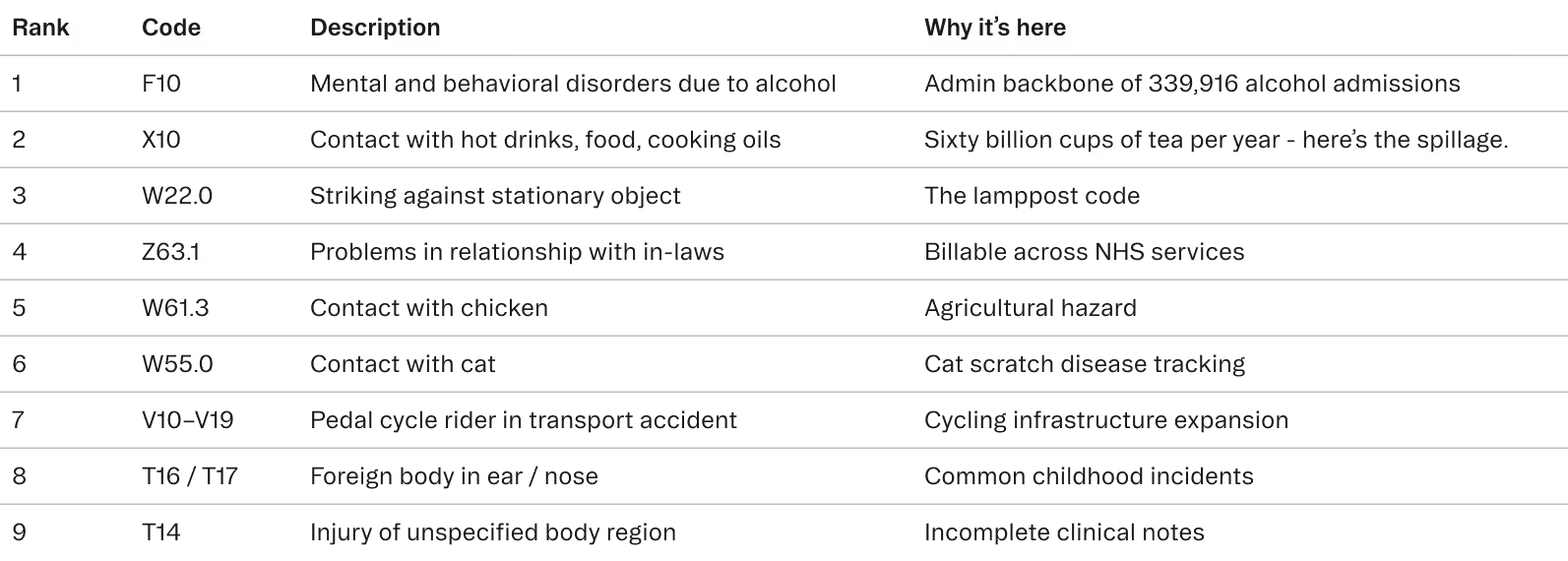
England’s relationship with alcohol is written in extraordinary geographic detail across NHS billing data - and the picture is getting worse. In 2023–24, there were 339,916 alcohol-specific hospital admissions, the highest rate since recording began. Under the broad definition, alcohol-related admissions exceeded one million in a single year. In 2022/23, alcohol-specific conditions accounted for 320,082 hospital admissions - 69% of them male.What makes this a distinctly British data story is the regional granularity. No other country publishes alcohol admission data at this level of local detail - and the variation it reveals is stark.
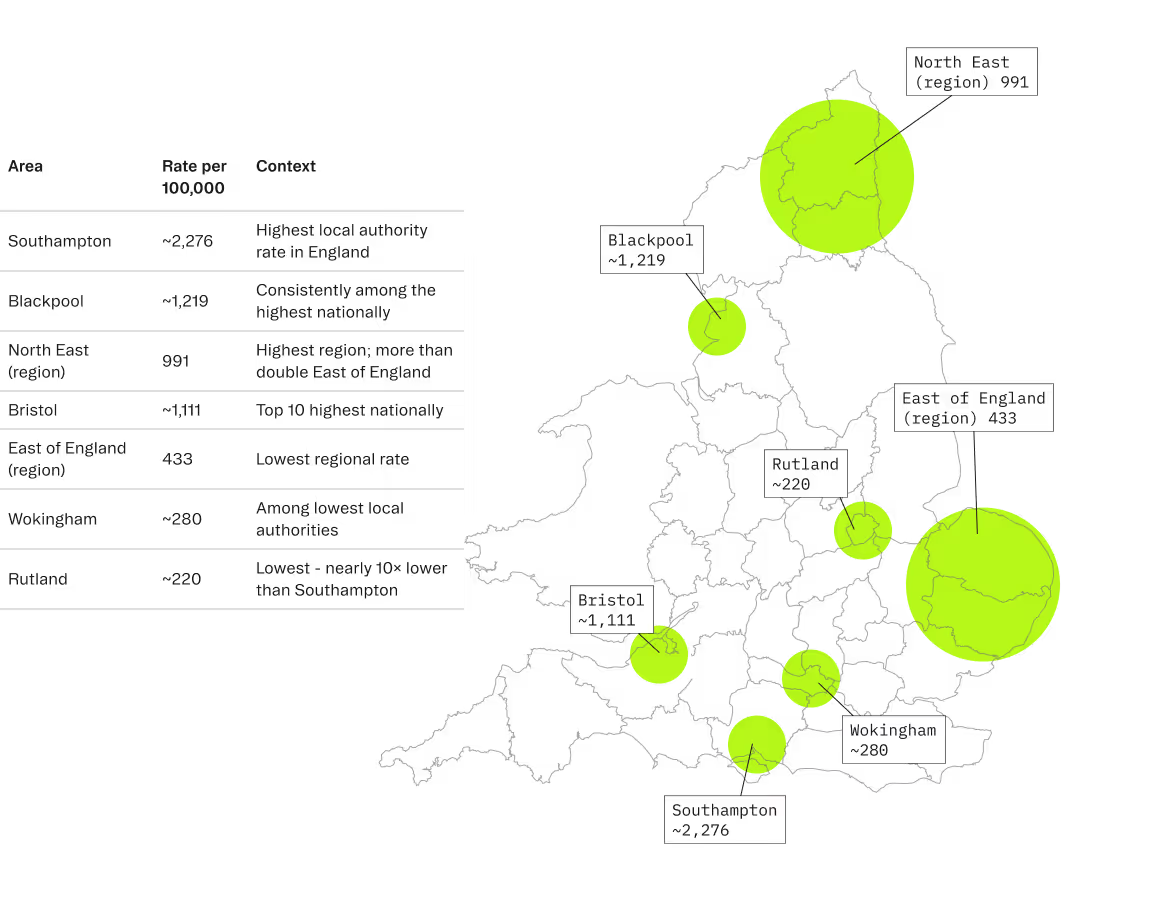
The rate in the most deprived areas is nearly double that of the least deprived. The data draws an economic and social map of England through billing codes - deprivation, geography, and the NHS’s decades-long relationship with alcohol, all visible in the coding.
Sources: OHID Local Alcohol Profiles for England; GOV.UK Alcohol Profile
February 2025; House of Commons Library Briefing CBP-7626 (March 2025)
Watch where you’re going! Great British hazards
Beyond alcohol, the NHS codes a quiet portrait of British daily life. Code W22.0 - striking against a stationary object - is the clinical record of what happens when 75% of the population admits to walking while looking at their phones. A survey by Living Streets estimated that 1 in 10 Brits - some 6.5 million people nationwide - had suffered a walk-and-text injury in the previous year. A later AO Mobile survey found 29% of the population had walked into a lamppost at least once, with Manchester topping the regional rankings.
The problem became so conspicuous that lampposts on London’s Brick Lane were padded as part of a public awareness campaign - a joke that landed, as these things do, because the data wasn’t. Then there is X10 - contact with hot drinks - the code for what happens when sixty billion cups of tea per year meet British multitasking. And Z63.1: problems in relationship with in-laws. Medically recognized, billable across NHS services, present since ICD-10’s introduction. No major revision has removed it.
Sources: Living Streets survey (2008); AO Mobile / YouGov distracted walking survey (2019); UK Tea & Infusions Association
The off-beat code rankings: UK edition
Ranked by NHS admission volume and cultural specificity 2 - the codes that reveal something distinctively British.
What the data tells us
The UK uses WHO ICD-10 - shorter codes, broader categories, no activity chapter. The same dog bite that generates W54.0XXA with Y93 activity context in the US produces W54 in the UK with no equivalent detail. That missing information is a design choice - one with consequences for population health research, resource allocation, and any AI system that must navigate both.
2 Codes are ranked by a combination of NHS admission volume and cultural specificity to Britain. Raw national coding volume for external cause codes is not publicly available at this granularity. Each entry is a real, active, billable WHO ICD-10 code anchored to a cited data source. Ranking position reflects illustrative value, not a claim that code 1 is filed more often than code 10.
Wild Boars, Beer Steins, and a CT Scanner at Oktoberfest.
Germany’s cities have an uninvited resident that steals laptops, disrupts trains, and occasionally sends people to A&E. Its biggest festival is now so medically significant it has its own on-site CT scanner.

Unwanted guests: The wild boar problem
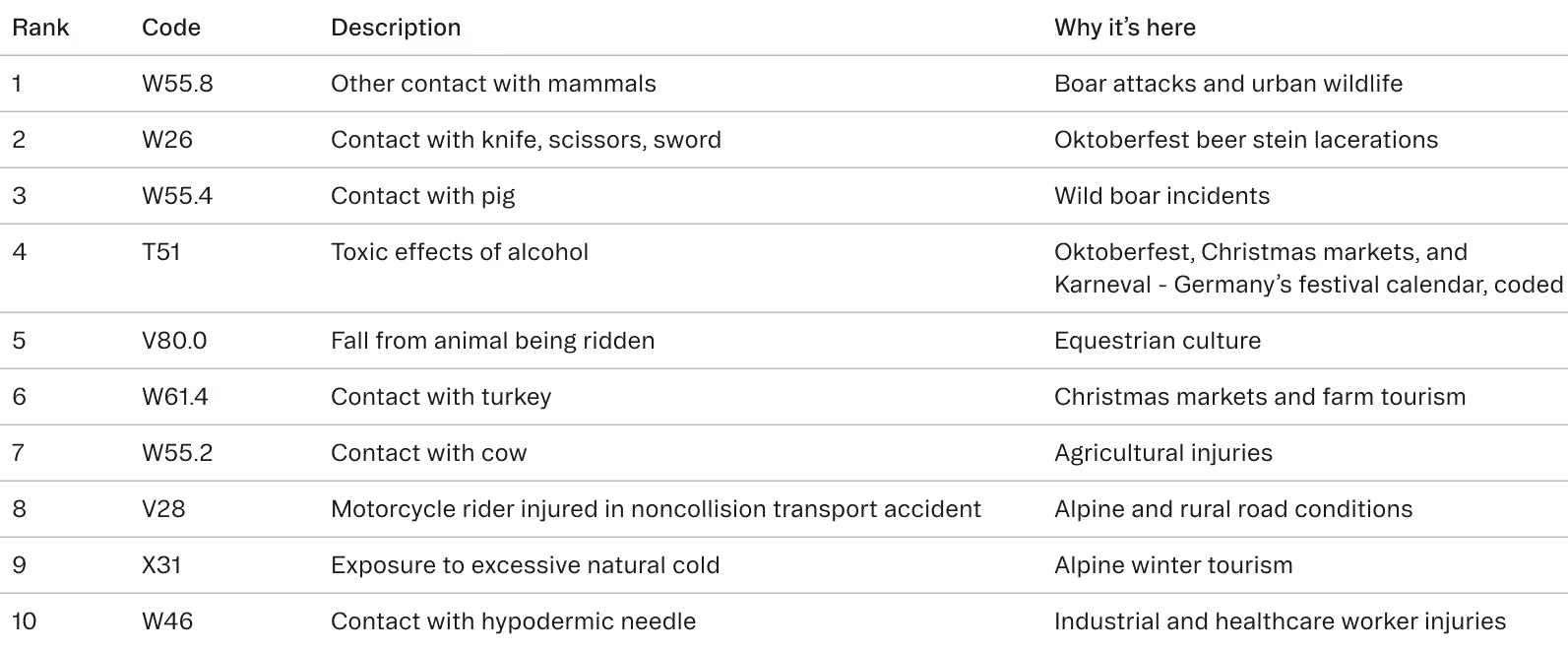
Berlin’s forests cover 20% of the city, creating habitat for wild boar that routinely wander into suburban gardens, parks, and beaches. In 2020, a boar grabbed a nude sunbather’s laptop bag at Teufelssee lake, prompting a widely-reported pursuit.
African Swine Fever has killed over 2,000 wild boar in western Germany since June 2024. Martens chewing through car wiring is so common that German car insurance has its own dedicated ’marten damage’ clause, paying out tens of thousands of times per year.
Source: German Animal Disease Information System (TSIS); BfArM ICD-10-GM documentation
Handle with care: Oktoberfest by the numbers
Munich’s Oktoberfest drew 7.2 million visitors in 2023. That year, more than 8,000 required medical attention - the highest figure since 2017. A mobile CT scanner has been deployed on the grounds every year since 2022 for head trauma triage.
Severe hand injuries spike 66% during the festival, driven by beer stein lacerations - a one-liter glass vessel that, apparently, resists being handled safely at scale. Internal medicine emergencies rise from a median of 109.5 to 131.0 admissions during the festival period.
Source: IVENA Registry (2014–2018); PMC hand trauma study (2013–2021); Deutsches Ärzteblatt International (2013–2022)
The off-beat code rankings: Germany edition
Ranked by event frequency and cultural specificity 3 within ICD-10-GM.
What the data tells us
Germany’s ICD-10-GM has different structure and clinical conventions from both the US and WHO systems. A hand laceration at Oktoberfest coded in ICD-10-GM follows different documentation rules than the same injury at an American county fair. A human coder switching between systems needs months of retraining. An AI built on a single national dataset simply fails.
3 Codes are ranked by a combination of documented event frequency and cultural specificity within ICD-10-GM. Raw national coding volume for external cause codes is not publicly available at this granularity. Each entry is a real, active, billable ICD-10-GM code anchored to a cited data source. Ranking position reflects illustrative value, not a claim that code 1 is filed more often than code 10.
Moose, Bicycles, and Saunas.
In Scandinavia, the coding story is written by three forces: very large animals on very dark roads, millions of people on bicycles in freezing winters, and a nation with more saunas than cars.

One moose per 40 people
Sweden has between 250,000 and 300,000 moose for 10.5 million people. This produces approximately 5,000 moose-vehicle collisions annually, causing 5–20 fatalities and around 500 injuries. A moose can weigh 550 kg with legs at car bonnet height - the vehicle strikes the legs and the body comes over the hood into the windshield. Road fencing reduces accidents by 80% where installed. The iconic yellow moose warning signs are reportedly Sweden’s most frequently stolen souvenir.
Source: Swedish National Wildlife-Vehicle Collision Registry; Swedish Transport Administration (2003–2015)
No helmet, no limit: The bicycle paradox
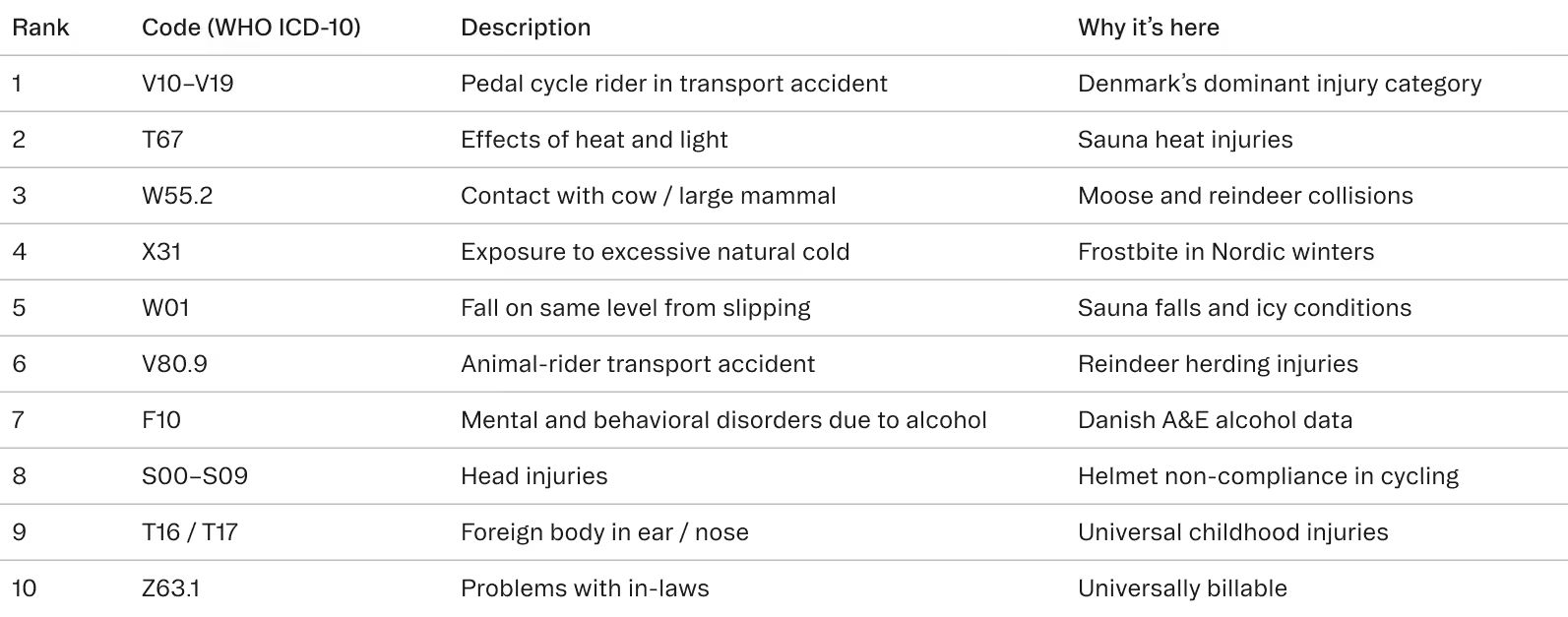
Denmark hospitalizes approximately 17,500 cyclists annually, but 70% of those injuries involve only the cyclist - no car, no pedestrian, just potholes, ice, or a Saturday night. Copenhagen’s cycling rates have increased 30% since 1998, while injuries per cyclist fell to a third. Denmark has no maximum blood alcohol limit for cyclists. Only 15% wear helmets.
The coding picture that results is instructive. Denmark’s cycling injury pattern is clinically closer to pedestrian falls than road traffic collisions - yet the WHO ICD-10 system requires they be filed under the transport accident chapter (V10–V19), the same chapter used for fatal motorway incidents. The system has no mechanism for distinguishing the two. Clinical severity and frequency tell different stories; the code gives you only one.
Source: Danish Road Directorate; Statistics Denmark; Copenhagen Municipality

Please do not pass out in the sauna
Finland has approximately 2 million saunas for 5.2 million people.
Sauna-related burns occur at a rate of 7 per 100,000, generating roughly one burn hospitalization per day. The most common mechanism: slips and falls (57.5%), followed by dizziness (30%). An estimated 30–40 Finns die from sauna-related heat annually, with June as the peak month - which is, if you think about it, the worst possible time to fall asleep in a sauna.
Source: Kenttämies & Karkola (2008), Journal of Forensic Sciences; Papp (2002), Burns; Helsinki Times
The off-beat code rankings: Nordic edition
Ranked by regional frequency and coding system specificity 4.
What the data tells us
The WHO base system cannot distinguish a sauna burn from a heatstroke, or a recreational cycling fall from a road traffic collision. These are not errors in the data - they are design constraints. Constraints that a coding AI working across borders must understand and navigate, not simply inherit.
4 Codes are ranked by a combination of regional frequency and coding system specificity within WHO ICD-10. Raw national coding volume for external cause codes is not publicly available at this granularity. Each entry is a real, active, billable WHO ICD-10 code anchored to a cited data source. Ranking position reflects illustrative value, not a claim that code 1 is filed more often than code 10.
Some things are universal
It is worth pausing on what is consistent across all four geographies - and, likely - across every healthcare system on Earth.

Spring optimism
Every spring, the same thing happens. The weather improves, public holidays arrive, and millions of people pick up tools they haven’t touched since autumn - with more ambition than preparation. The codes that follow are entirely predictable.
In England, there are approximately 8,500 hospital admissions per year for DIY and gardening-related injuries, with 56% occurring in the six-month window between April and September.
The lawnmower is the most common culprit: the age group most affected is 40 to 74 year-olds, who account for 58% of admissions. Ninety percent of all DIY and gardening injury admissions are male. In the United States, lawn and garden equipment injuries generate an estimated 3.2 million emergency attendances over a decade - approximately 320,000 per year - with lawnmowers alone responsible for around 26,679 hospitalizations annually.
The codes themselves - W27 (contact with non-powered hand tool), W28 (contact with powered lawnmower), W29 (contact with other powered hand tools and household machinery) - exist in all national ICD-10 variants. They are among the most seasonally predictable entries in the entire system. In at least two of the four countries covered by this report, the coding system has already anticipated Easter weekend. The others almost certainly follow the same pattern - but have yet to publish the data to prove it.
Sources: Royal College of Surgeons of England / NHS Digital (2014–2017); NHS England (2019); LawnStarter / CPSC National Electronic Injury Surveillance System (2010–2019); Johns Hopkins Medicine lawnmower injury study (2018)
Things children will put in their ears and noses
In NHS England, an average of 1,218 nasal foreign body removals and 2,479 aural foreign body removals are performed on children every year, at a total annual cost of approximately £2.9 million.
Children aged 1–4 favour their noses; those aged 5–9 prefer their ears. Common objects include jewellery, pencils, pieces of plastic toy, and - this being Britain - cotton buds.
The figure has not declined over any measured period. The title of the peer-reviewed study that established this, published in the Annals of the Royal College of Surgeons of England, is - without editorial embellishment - Will Children Ever Learn?
In the United States, ear foreign bodies alone generated an estimated 446,819 emergency department visits over a single decade. The mean patient age was 7.2 years. The codes T16 and T17 exist in all national ICD-10 variants.
Problems with in-laws (Z63.1). Billable in the US, the UK, Germany, Denmark, and approximately 100 other countries. Classified under ’problems related to primary support group.’ Present in every major ICD-10 revision. No country has removed it. Several have had the opportunity.
Sources: Morris et al., Annals of the Royal College of Surgeons of England (2018); Xiao et al., International Journal of Pediatric Otorhinolaryngology (2020); ICD-10-CM 2026; ICD-10 WHO current edition
What the codes are telling us
Step away from the duck! Step back from the beer stein lacerations and the lamppost collisions and the Danish cyclists with no helmets and no blood alcohol limit. Look at the full picture.
Four countries. Four healthcare systems. Four versions of ICD-10 that share a common ancestor and diverge in ways that are not random - they are geographically, economically, and socially specific. America’s deer problem is written in its rural highway data. Britain’s class geography is visible in its alcohol admission rates. Germany’s festival calendar shows up in hand laceration spikes. Denmark’s cycling culture looks, to a coding system trained elsewhere, like a road accident epidemic.
And underneath all of it: a system that processes billions of clinical encounters every year - determining where healthcare money flows, where public health resources go, and which patients get flagged for follow-up - operating at an error rate that costs the industry $36 billion annually in the US alone, and that, in at least one documented case, missed three in every four suicide attempts in an entire national dataset.
The codes are not the problem. The codes are, in their strange and hyper-specific way, trying to tell the truth. The problem is reading them accurately - across 72,000 variations, across systems that describe the same event in fundamentally different ways, across clinical notes written in shorthand by exhausted clinicians - at a scale and consistency that neither human coders working under time pressure nor AI systems trained on single-country data have been able to reliably achieve.
Symphony for Medical Coding
A clinical coding API that applies coding rules, returns auditable predictions, and integrates in a single call. Built for clinical documentation, RCM, and EHR workflows. No training data. No retraining cycle. No implementation project.
Sources
Medical Coding Industry. American Medical Association ($36B annual cost estimate); JAMIA (coding error cost analysis); Crowe RCA benchmark (2022) (11% denial rate); Becker’s Hospital Review ($118 rework cost per claim); MGMA (65% of denied claims never resubmitted); Fathom Health (68% of denials from coding errors); GAO Medicare FFS improper payments FY 2024 ($31.7B); Corti/EMNLP 2025 peer-reviewed study (arxiv.org/abs/2603.00221)
United States. State Farm Annual Animal Collision Report (July 2024–June 2025); Insurance Information Institute; MoneyGeek; US Consumer Product Safety Commission fireworks report (2024); Pew Research Center / NEISS data; ICD-10-CM 2026 (icd10data.com)
United Kingdom. NHS Hospital Episode Statistics (digital.nhs.uk); OHID / GOV.UK Alcohol Profile February 2025; Local Alcohol Profiles for England March 2023; House of Commons Library Briefing CBP-7626 (March 2025); Living Streets distracted walking survey (2008); AO Mobile / YouGov distracted walking survey (2019); UK Tea & Infusions Association
Denmark / Nordic. Danish Road Directorate / Statistics Denmark; Copenhagen Municipality cycling data; Swedish National Wildlife-Vehicle Collision Registry; Swedish Transport Administration (2003–2015); Kenttämies & Karkola (2008), Journal of Forensic Sciences; Papp (2002), Burns; Helsinki Times / Statistics Finland
Universal. Morris et al., Annals of the Royal College of Surgeons of England (2018); Xiao et al., International Journal of Pediatric Otorhinolaryngology (2020); ICD-10-CM 2026; ICD-10 WHO current edition