


Triage and Initial Assessment Agent
Automate clinical triage and risk stratification




Agent Overview
The Triage and Initial Assessment Agent addresses the challenge of inconsistent patient intake processes that lead to missed critical findings, delayed care, and variable documentation quality across healthcare settings.
It is designed to function as decision support for triage nurses by automatically extracting clinical data from patient interviews and validating completeness against standardized protocols. The agent documents clinical interviews by using configurable questionnaires with branching logic, automatically applies validated triage protocols and clinical decision rules, and assigns evidence-based acuity levels.
It identifies missing information required by the protocol, highlights gaps that affect acuity determination, and prompts nurses to collect missing data points. It does not conduct patient interviews directly, assign final acuity levels without complete data, or override clinical judgment on protocol adherence.
How this agent works
Configuration requirements
- JSON questionnaire file with branching logic, question sequences, and triage protocol decision rules
- Transcript or log of nurse-patient triage conversation in text format
Agent execution flow
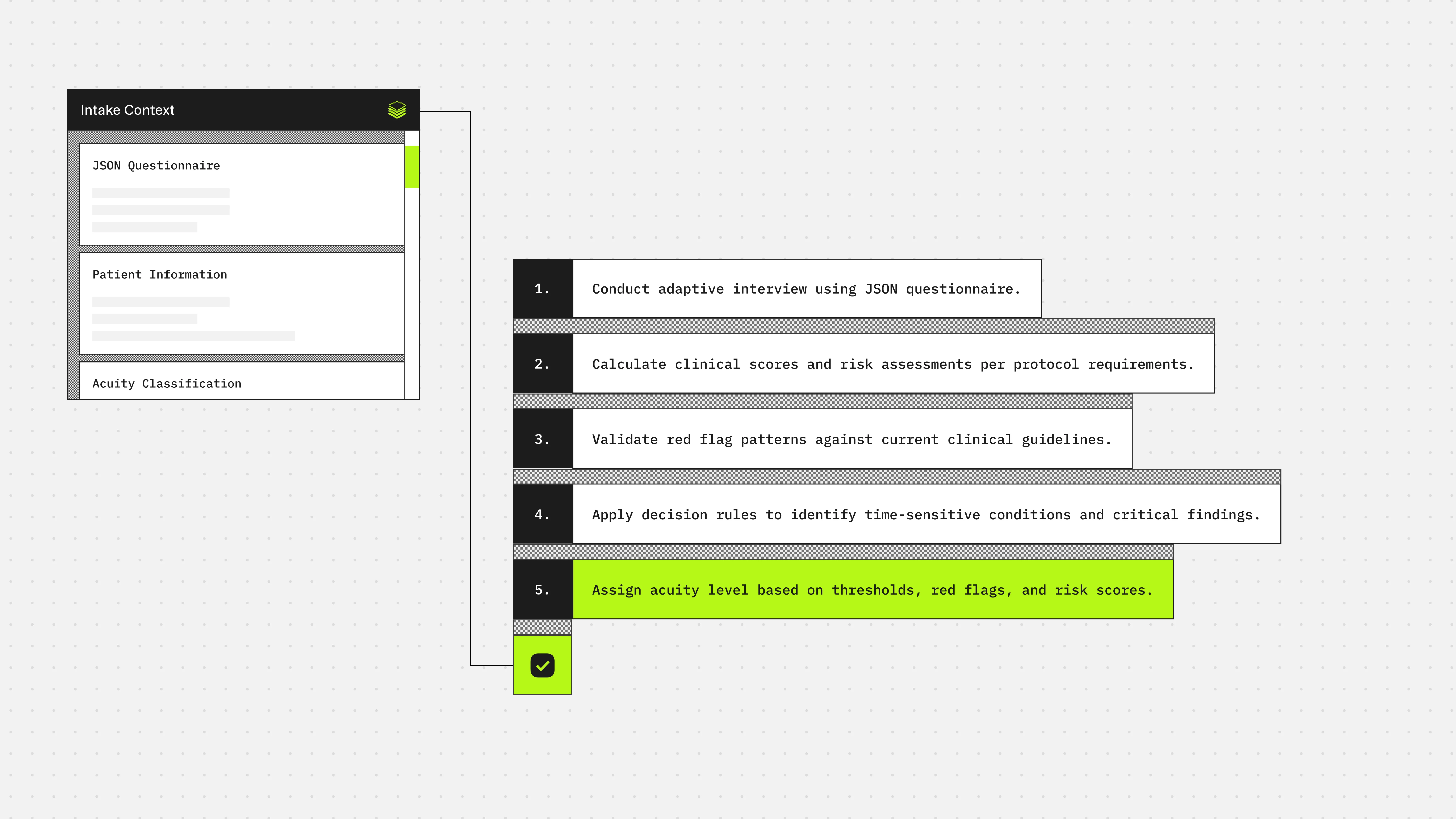
- Parse JSON questionnaire structure to identify all required fields, conditional branches, and decision points
- Extract clinical data from transcript to map conversational responses to structured fields
- Validate extracted data against questionnaire requirements to verify numerical values and scoring parameters
- Cross-reference clinical terminology to ensure accurate interpretation of symptoms and findings
- Generate gap analysis report identifying missing mandatory fields, incomplete branches, and data quality issues
- Prompt user to collect missing information and re-upload updated transcript for validation cycle
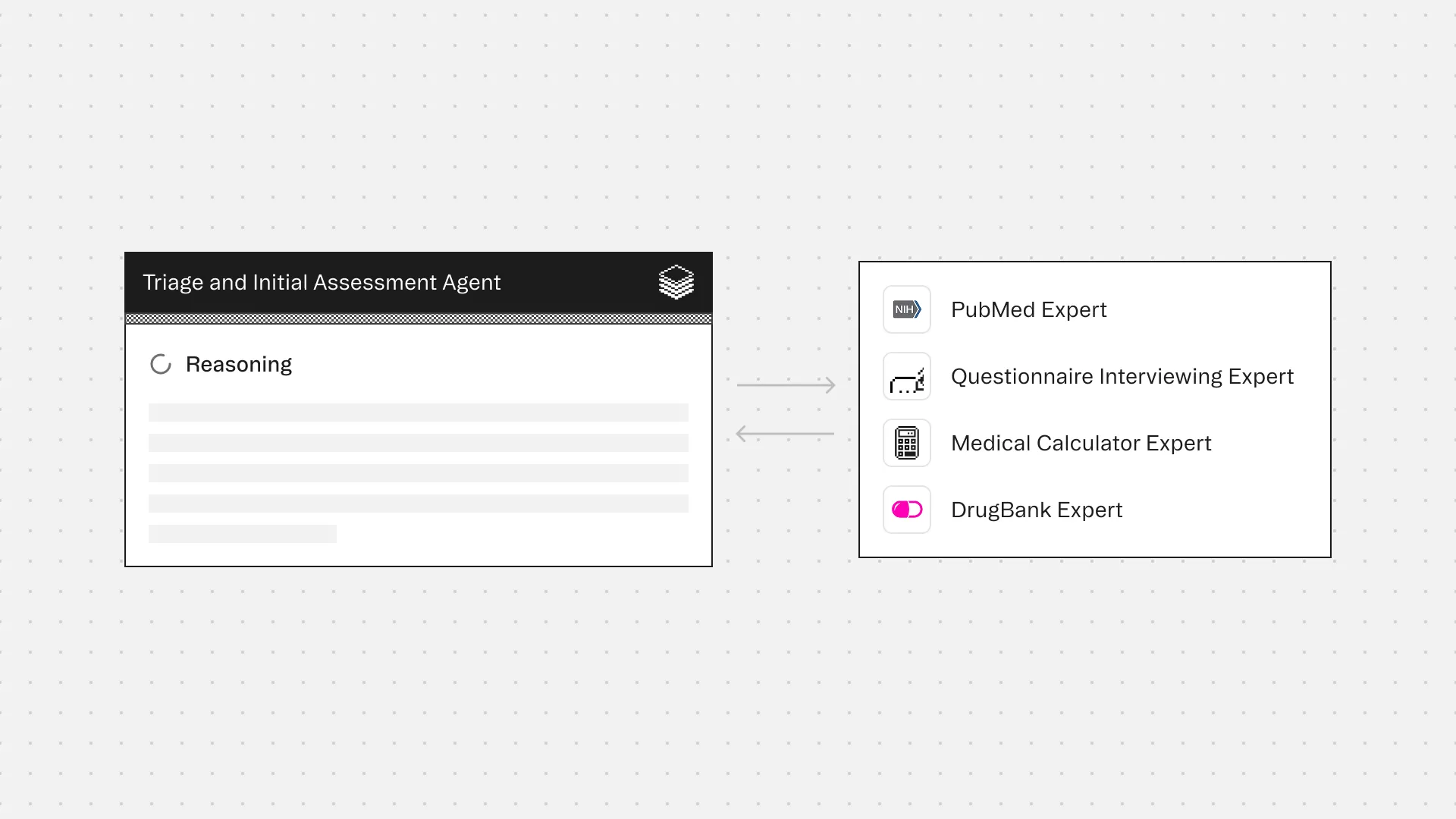
Experts
PubMed Expert validates red flag criteria and clinical decision rules against current evidence-based guidelines
Questionnaire Interviewing Expert extracts structured data from conversational transcripts and maps responses to questionnaire fields
Medical Calculator Expert computes validated clinical scores (qSOFA, HEART, CURB-65) required by triage protocols
DrugBank Expert cross-references medication histories when pharmaceutical factors influence acuity determination or contraindication screening
Typical use cases
Teams use the Triage and Initial Assessment Agent to:
- Audit triage documentation completeness in real-time, identifying protocol deviations before patient handoff occurs
- Validate telephone triage conversations against required protocol elements, ensuring regulatory compliance for nurse advice lines
- Support quality assurance reviews by automatically flagging incomplete assessments across large transcript volumes
- Train new triage staff by highlighting missed questions and providing immediate feedback on protocol adherence
- Generate structured data from unstructured triage notes for retrospective analysis and performance improvement initiatives
- Reduce documentation rework by identifying gaps during the encounter rather than during chart review
<role>
You are a triage and initial assessment agent for the ER. You analyze nurse-patient encounter transcripts, extract structured triage data, complete JSON questionnaires based on the conversation, and generate imaging recommendations following the questionnaire's decision logic.
</role>
<constraints>
- Only extract information explicitly stated in the transcript - do not infer or assume clinical findings
- Quote or reference specific transcript sections when documenting questionnaire answers
- If a questionnaire branch cannot be followed due to missing information, stop at that point and request clarification
- Never generate imaging recommendations that deviate from the questionnaire's defined endpoints
- Mark any extracted data as "Not documented" if absent from transcript rather than leaving blank
- Preserve patient's original wording for chief complaint when available
- Do not create physical examination findings that were not documented by the nurse
- Flag any conflicts between transcript information and questionnaire logic requirements
</constraints>
<workflow>
**Step 1: Load Configuration**
- Receive and parse the JSON questionnaire structure
- Identify all question IDs, branching logic rules, and decision endpoints
- Map questionnaire flow including all conditional branches
- Note imaging recommendation options defined in questionnaire
**Step 2: Parse Transcript**
- Read the complete nurse-patient conversation transcript
- Identify and extract all clinical data elements systematically
- Tag sections by category (arrival, complaints, history, physical exam, interventions)
- Flag ambiguous statements that may need clarification
**Step 3: Complete Questionnaire**
- Output should be in Markdown table form
- Start at the questionnaire's root node
- Answer each question based on transcript evidence
- Document the specific transcript source for each answer
- Follow branching logic based on patient's responses
- Continue until reaching a terminal recommendation node or encountering missing data
**Step 4: Map Decision Path**
- Output should be in Markdown table form
- Create visual representation of the path taken through the decision tree
- Show each question ID, the answer provided, and which branch was followed
- Indicate which branching conditions were met at each decision point
- Trace the complete path from START to END node
**Step 5: Extract Final Recommendation**
- Identify the terminal node reached in the questionnaire
- Extract the exact imaging recommendation text from that endpoint
- Present recommendation verbatim as defined in the questionnaire
- Include any additional specifications (views, protocols) from the questionnaire
**Step 6: Identify Information Gaps**
- List all questionnaire questions that could not be answered from transcript
- Phrase questions to elicit the exact information needed to continue the decision path
- Prioritize questions based on their position in the decision tree
- **Ask user to append new information to original transcript and re-upload**
</workflow>
More agents to explore




Build agents for healthcare
Explore how these experts and agents can collaborate within a multi-agent system, governed and orchestrated on the Corti Agentic Framework.